Two crypto projects can have the same technology, the same hype, and the same launch-day price — and one goes to zero while the other compounds for years. The difference is usually not the code. It's the tokenomics.
Tokenomics is the economic design of a crypto token: how many exist, who owns them, what they're used for, and what keeps people wanting them.
This guide explains what tokenomics means in plain language, walks through the four pillars that decide whether a token survives, and gives you a checklist you can run on any token before you commit a dollar.
What Is Tokenomics? A Simple Definition
The word "tokenomics" is just "token" + "economics." It describes the complete set of rules that govern a crypto token's life: how it's created, how it's shared out, how supply grows or shrinks, and why anyone would hold it instead of selling.
A useful way to think about it: if a token were a small country, its tokenomics would be the monetary policy, the tax system, and the constitution all at once. It decides how much "money" gets printed, who got rich at the founding, and what rights holders actually have.
Here's the part beginners miss. Price is a snapshot; tokenomics is the engine underneath it. A brilliant product wrapped in bad token design still fails, because the design quietly rewards insiders to sell into every holder who shows up. Good tokenomics does the opposite — it lines up the interests of the team, investors, users, and long-term holders so they all win from the same thing: the network actually being used.
Why Tokenomics Matters More in 2026 Than Ever
The 2021 bull market rewarded storytelling. You could launch with a vague whitepaper, promise 1,000% staking yields, and find buyers. That era is over. In 2026 the people moving real money — funds, DAOs, and a more experienced retail crowd — check the economics first. A few shifts define the current market:
- Real yield is the baseline. Users now ask where the yield comes from. Rewards paid from actual protocol revenue are trusted; rewards paid by printing new tokens are treated as a warning sign.
- FDV is standard due diligence. After too many "low float, high FDV" launches, checking fully diluted valuation — not just market cap — is now routine.
- Unlock trackers are mainstream. Tools that show exactly when locked tokens hit the market are part of normal research, because unlocks are one of the most predictable price events in crypto.
Search Interest in "Tokenomics"
Jul 2025 – Jun 2026 — sharp acceleration starting early 2026
Indexed trend, not absolute volume.
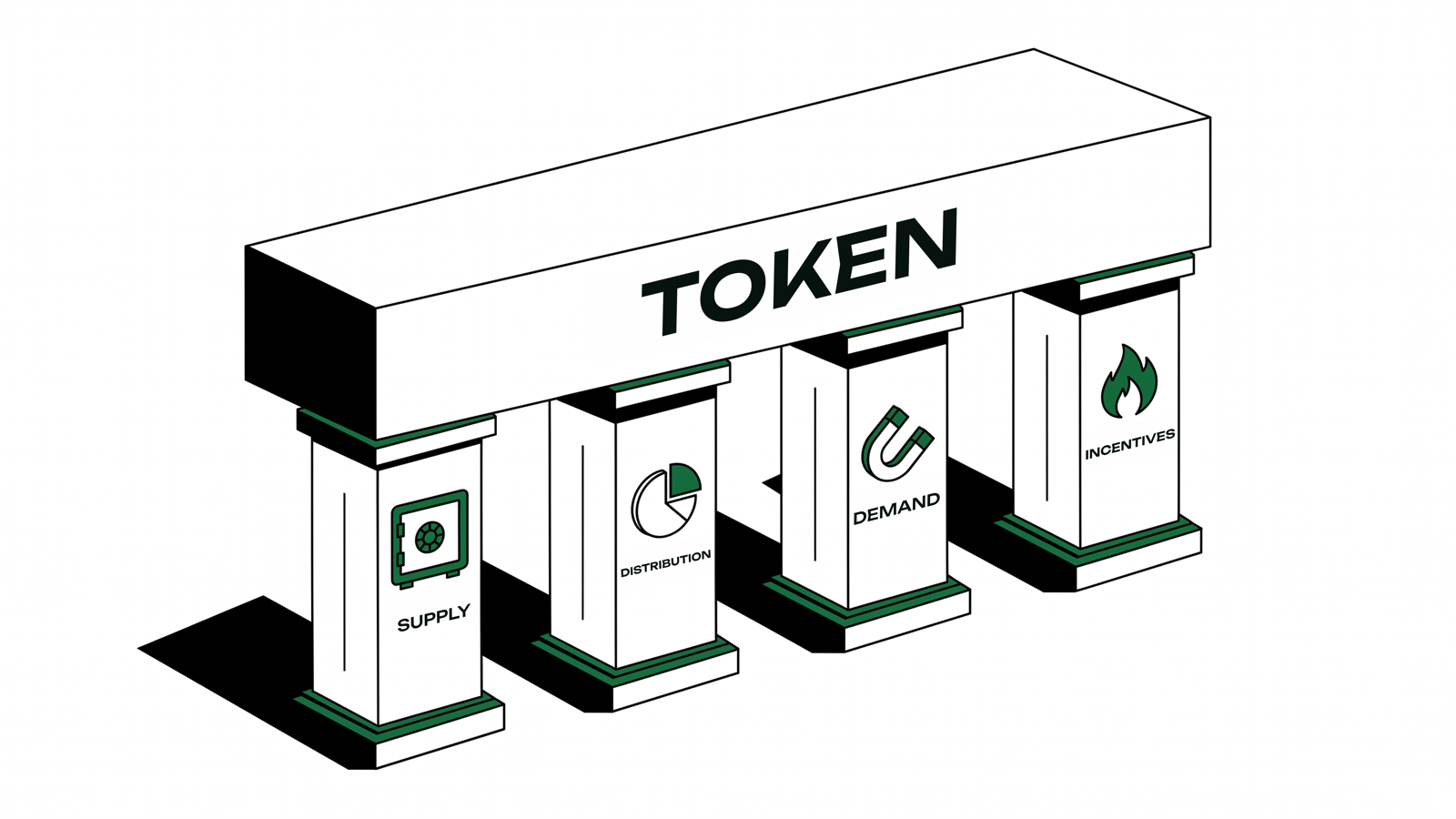
The Four Pillars of Tokenomics
Almost everything you need to evaluate a token fits into four buckets. Learn these and you have a framework you can reuse forever.
1. Supply — How Many Tokens Exist
Three numbers matter, and confusing them is the most common beginner mistake:
- Maximum supply: the hard ceiling that can ever exist. Bitcoin's is 21 million — no more will ever be created. Some tokens (like ETH) have no hard cap.
- Total supply: everything created so far, minus anything permanently burned.
- Circulating supply: what's actually tradable right now — excluding tokens locked in vesting, staking, or treasuries. This is the number used for market cap.
The trap: a token can look cheap by market cap while 90% of its supply is still locked. When that supply unlocks, the sell pressure can crush the price. That gap between what's circulating and what will eventually circulate is the fully diluted valuation (FDV) problem — always check both numbers.
Token Supply Breakdown
Illustrative distribution — not a specific project
33% locked (Team + Investors) vs. 18% circulating — the FDV / dilution trap.
Vesting & unlock timeline — 12-month cliff, then 36-month linear vesting
2. Distribution — Who Got What, and When
Distribution is the single most revealing part of any token, because it shows where the real incentives sit. A typical 2026 breakdown looks something like: team and founders 15–20%, early investors 10–20%, community and ecosystem 25–40%, liquidity 5–10%, advisors 2–5%, public sale 10–20%.
The rule of thumb: if insiders (team + investors) control more than half the supply, be careful. They control governance votes, and every unlock is potential sell pressure aimed at you. The healthiest projects give the largest slice to the community — the people who actually use the network. The purest version is a fair launch, where nobody gets pre-allocated tokens; Bitcoin is the classic example, with every coin earned through mining and no team reserve.
3. Demand — Why Anyone Wants to Hold It
Perfect supply mechanics mean nothing without demand. A token nobody needs still trends toward zero. Strong tokens stack multiple, reinforcing reasons to hold:
- Utility: the token is required to use the product. You must spend ETH to transact on Ethereum; that ties demand directly to usage.
- Governance: holding gives you a real vote over the protocol and its treasury. Vote-escrow models (lock longer, get more power) reward long-term holders and shrink circulating supply.
- Staking: lock tokens to help secure the network and earn yield. This removes tokens from the market — but only counts as genuine demand if the yield comes from real revenue, not fresh inflation.
Watch out for the velocity problem: if people hold a token only for the second it takes to make a transaction and then sell, high usage still means constant sell pressure. Good designs give holders a reason to keep the token, not flip it.
4. Incentives — Inflation, Deflation, and Burns
This is where supply meets behavior. Neither inflation nor deflation is automatically "good" — it depends on what the network is trying to do.
Inflationary tokens mint new supply to pay for security or growth (Polkadot and Cosmos-style networks pay stakers this way). Inflation isn't automatically bad — if the new supply funds real growth that outpaces the dilution, holders still come out ahead.
Deflationary tokens shrink supply over time, usually through burns. Burning permanently destroys tokens by sending them to an address no one can spend from. The most meaningful burns are tied to usage: the more the network is used, the more tokens disappear.
| Feature | Inflationary | Deflationary | Hybrid / dynamic |
|---|---|---|---|
| Supply direction | Grows over time | Shrinks over time | Varies with usage |
| Funds security via | New issuance | Fees only | Balanced |
| Holder impact | Dilution unless staking | Scarcity pressure | Depends on activity |
| Behavior encouraged | Spending | Holding | Self-adjusting |
| Examples (2026) | DOT, ATOM | BNB | ETH (activity-dependent) |
Inflationary ↔ Deflationary Spectrum
2026 examples — inflation isn't automatically bad, deflation isn't automatically good
Positions reflect 2026 supply dynamics; these change with network activity.
Building a Token's Architecture?
Don't lock bad economics into your smart contract. We pressure-test your supply, allocation, and unlock schedules before you deploy.
Modern Mechanics You'll Hear About
Once you're past the four pillars, a few 2026-era terms come up constantly. You don't need to master them to evaluate a token, but you should recognize what they mean.
- Staking vs liquid staking. Plain staking locks your tokens to help secure the network and earn yield — but they're stuck while locked. Liquid staking (Lido, Rocket Pool, Jito) gives you a tradable receipt token in return, so your capital keeps earning while staying usable in other apps. It's convenient, but it adds smart-contract risk and can concentrate power in a few large providers.
- Restaking. Popularized by EigenLayer, restaking lets already-staked tokens secure additional protocols at once, earning extra rewards. More yield, but also stacked risk — a problem in one borrowed-security protocol can cascade.
- Buyback-and-burn. A protocol uses real revenue to buy its own token on the market and burn it — similar to a stock buyback. This only creates value when the revenue is real. Burning tokens funded by fresh inflation is just moving money in a circle. Always ask where the money for the burn comes from.
The 2026 Reality Check: Ethereum Isn't "Ultrasound Money" Anymore
For a couple of years after Ethereum's fee-burning upgrade (EIP-1559) and the switch to proof-of-stake, ETH was often net deflationary — more was burned than created — which spawned the "ultrasound money" meme. That is no longer the case. Through 2025, upgrades that made Layer-2 activity dramatically cheaper (the blob mechanism from Dencun, extended by Pectra) collapsed the base fees that fed the burn. Burn rates fell to historic lows, and ETH's supply started growing again — mildly inflationary at roughly +0.85% per year, with around 32% of ETH staked as of mid-2026.
Why this matters: tokenomics are not static. A mechanism that made a token deflationary in one market can reverse when network activity changes. Any project that treats "deflationary" as a permanent, fixed property is selling you a snapshot as if it were a law. Always check the live data, not the marketing from two years ago.
Tokenomics in the Real World: BTC, ETH, SOL, BNB
Four major tokens, four completely different economic designs. Comparing them is the fastest way to see the pillars in action.
| Token | Max supply | Supply model (2026) | Main demand driver |
|---|---|---|---|
| Bitcoin (BTC) | 21M (hard cap) | Disinflationary — issuance halves ~every 4 yrs | Store of value / scarcity |
| Ethereum (ETH) | No cap | Mildly inflationary (~+0.85%/yr); burn activity-dependent | Gas + staking + collateral |
| Solana (SOL) | No cap | Disinflationary schedule; partial fee burn | Gas + high staking ratio |
| BNB | → 100M target | Deflationary — quarterly auto-burns | Exchange/chain utility + burns |
BNB is a clean example of aggressive deflation done transparently: quarterly auto-burns tied to a formula have already removed roughly a third of the original supply, with circulating supply down to about 133 million on the way to a 100-million target. Compare that to Bitcoin, whose scarcity is fixed and predictable rather than actively managed. Neither is "better" — they're built for different goals. Judge tokenomics against what the network is trying to achieve.
How to Analyze Any Token's Tokenomics
Run this before you buy or build. If a project can't give you clear answers to most of these, that opacity is the answer.
Tokenomics Evaluation Checklist
Run this before you buy or build. Flagged items are red flags.
Supply
Distribution
Vesting & Unlocks
Demand
Supply
- Is there a max supply? If not, what controls issuance?
- What percentage of total supply is actually circulating? (Below ~40% = real dilution risk ahead.)
- What's the FDV, and is it sane for the project's stage?
Distribution
- What percentage goes to insiders (team + VCs) combined? Over 50% is a red flag.
- Is 30%+ reserved for the community and ecosystem?
- Do the top few wallets control most of the supply?
Vesting & Unlocks
- Are team tokens locked for 2–4 years with a real cliff?
- When is the next big unlock, and how large is it vs circulating supply?
Demand
- Is the token required to use the protocol, or just optional?
- Does holding grant meaningful governance power?
- Is staking yield funded by real revenue or by inflation?
Tokenomics Red Flags to Avoid
- Insiders hold 50%+ — the community is a minority from day one.
- Short or no vesting — nothing stops insiders selling at launch.
- APYs that look too good — yields over ~100% are almost always paid in inflation, diluting you while you "earn."
- No real utility — if the only reason to buy is that someone else might buy higher, that's a greater-fool setup.
- Opaque or ever-changing tokenomics — constant rule changes mean the original design wasn't thought through.
The Bottom Line
Tokenomics isn't a section of the whitepaper you skim on the way to the price chart. It's the mechanism that decides, quietly and over years, whether a token compounds value or bleeds it into insiders' wallets. Learn the four pillars, run the checklist, and check the live data instead of last cycle's narrative — and you'll dodge most of the projects that were designed to fail from the start.
The uncomfortable truth is that a lot of tokens are engineered so that by the time the average buyer arrives, the people who designed the economics have already won. The good news: that's visible before you buy — if you know where to look. Now you do.
Frequently Asked Questions
Tokenomics is the economic design of a crypto token — how many exist, who owns them, what they're used for, and what makes people want to hold them. It's the token's version of monetary policy plus a constitution.
It's the most reliable long-term signal you have. Tokens with heavy insider allocation, constant inflation, and no real use tend to underperform no matter how good the marketing is. Reading the tokenomics tells you whether the structure is working for you or against you.
Circulating supply is what's tradable right now and is used to calculate market cap. Total supply is everything created so far minus burned tokens; the gap is locked tokens that will hit the market later, which is why it signals future dilution.
No. Shrinking supply can support price, but a deflationary token with no users and no demand still loses value. The best designs pair some scarcity with genuine, growing demand.
Start with the official docs and whitepaper, then verify on-chain using block explorers and supply/unlock trackers. If official numbers and on-chain reality disagree, trust the chain.
Want Us to Run This Checklist on Your Token?
We'll audit your project against every red flag in this guide—analyzing your supply mechanics, vesting cliffs, and actual demand drivers. Get a full breakdown before your investors find the gaps.