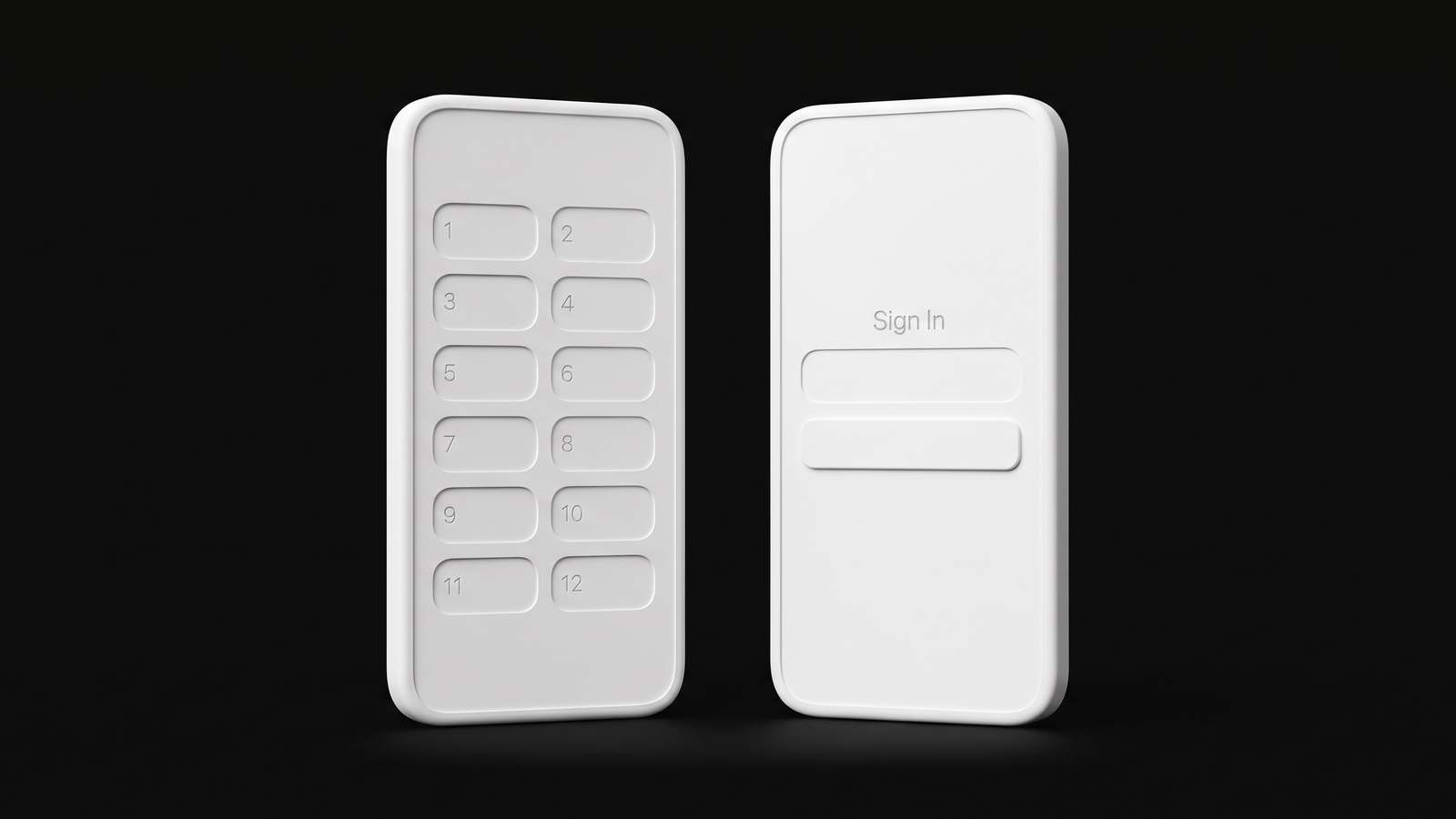
Two onboarding flows can run on identical smart contract infrastructure — same chain, same account abstraction stack, same audited code — and one loses 80% of new users at a seed-phrase screen while the other gets them transacting in under thirty seconds. The contracts aren't the difference. The screen is.
What Is an Embedded Wallet? A Simple Definition
An embedded wallet is a crypto wallet that lives inside your product instead of asking the user to install one first. There's no browser extension, no "connect wallet" button pointing at MetaMask, no twelve-word phrase to write on paper and lose. The user signs in the way they'd sign in to any other app — email, Google, Face ID — and a wallet is created and secured behind the scenes.
The technology stack that makes this possible is now standard enough to name in three parts: passkeys (WebAuthn) handle authentication using the device's biometric hardware instead of a password; MPC (multi-party computation) splits the private key across multiple parties so no single point — not even the provider — ever holds the whole thing; and account abstraction (ERC-4337) turns the wallet into a smart contract account, which is what makes gas sponsorship, session keys, and transaction batching possible in the first place.
None of these are new individually. What's new in 2026 is that a team can buy all three, integrated, from a single SDK, and stop thinking about them as separate problems. There's also a fourth piece worth knowing about even if it's not the headline: EIP-7702, which lets an existing externally-owned account (a regular MetaMask-style wallet) temporarily behave like a smart contract account without forcing the user to migrate to a brand-new address. It matters less for greenfield embedded-wallet products and more for teams with an existing user base of EOA holders who want account-abstraction features without a migration project.
One naming confusion worth clearing up early: "embedded wallet" and "programmable wallet" describe the same infrastructure from two different sides of the API. Embedded is the user-facing framing — invisible, built into the app. Programmable is the developer-facing framing — controlled through code rather than a browser extension UI. If a vendor's docs seem to contradict each other on this, that's usually why.
Why This Matters More in 2026 Than Ever
Every consumer crypto product has run into the same wall: the moment a new user hits a seed phrase, activation collapses. It doesn't matter how good the product is downstream — a screen that says "write down these twelve words, in order, and never lose them, because we can't recover them for you" reads as a liability warning to anyone who isn't already a crypto native.
The framing that matters most for 2026 specifically: the industry's attention has shifted from acquisition to retention. Getting a user through sign-up was the hard problem for years; wallets were built like raw infrastructure, and that showed in every screen. Now that passkeys, MPC, and account abstraction are mature enough to buy off the shelf, the differentiator isn't whether a user can get through onboarding — it's whether they come back. Wallet architecture, at this point, is product architecture — it belongs in the room where product decisions get made, well before the design team is handed a result.
Two things made embedded wallets the default answer instead of a workaround:
- Passkeys went mainstream outside crypto first. Apple, Google, and most major platforms normalized biometric sign-in for banking and email years before crypto adopted it, so the interaction pattern needs zero explanation to a new user.
- Paymasters made "no gas fees" a claim you can actually keep. Account abstraction lets an app sponsor gas directly or let the user pay in the same stablecoin they're already transacting in, instead of forcing them to hold a separate gas token they've never heard of before they can do anything.
The result is a wallet creation and first-transaction flow that can look, to the user, indistinguishable from any fintech app — right up until it can't.
The SDK Market Is Already Crowded
Privy, Para, Magic, Openfort, Alchemy, Circle, and Coinbase all sell some version of this stack today, and the honest answer is that most of them are converging on similar capabilities: passkey or social login, MPC or shared-custody key management, gas sponsorship, and multi-chain support. The differentiation that actually matters when evaluating providers isn't "do they support account abstraction" — nearly all of them do now — it's:
- How much of the key management is non-custodial by default versus opt-in
- Whether session keys and spending limits are first-class or bolted on
- How the SDK degrades when a user changes devices and needs to recover access
- Pricing at scale — some charge per wallet created, others per active wallet, others per transaction sponsored
Under the hood, key management generally falls into one of three models, and it's worth knowing the honest trade-offs rather than trusting a vendor's one-line summary. MPC splits the private key into shares distributed across parties — no complete key ever exists in one place, and specialized providers can get a signature generated across shares in under 20 milliseconds, which is fast enough that users never notice the cryptography happening. TEE (trusted execution environment) keeps the key whole but isolated in secure hardware, trusting the chip manufacturer rather than distributing trust across parties. Custodial is the simplest to implement and the one to be most careful claiming isn't happening — if a provider can unilaterally move funds without the user's cryptographic participation, calling it "non-custodial" in your own marketing is a claim you need to be able to back up yourself, whatever the SDK's homepage says.
Embedded Wallet Providers, Side by Side
The four questions that actually separate them once account abstraction is table stakes
| Provider | Auth methods | Key custody model | Gas sponsorship | Chains supported |
|---|---|---|---|---|
| Privy | Email, SMS, social login, passkey, plus linking external wallets (MetaMask, Coinbase Wallet) | Non-custodial — TEE (secure enclave) + key splitting | Native, automated (app can keep sponsor wallets funded) | EVM (Ethereum, Base, Arbitrum, HyperEVM, Eclipse, etc.), Solana, Bitcoin, TRON, Stellar |
| Para | Passkey-first, plus email and social login | Non-custodial — passkey + MPC (distributed key generation), device-bound recovery (iCloud Keychain / Android Keystore) | Via partner integrations, not native by default | EVM, Solana, Cosmos |
| Magic | Email, SMS, social login (passwordless-first) | Non-custodial — delegated-key MPC | Not native — requires a separate paymaster integration | EVM-compatible chains, additional chains via configuration |
| Openfort | Email, social login, passkey | Smart account + "OpenSigner" — open-source, self-hostable key-management stack | Native, included on the free tier (bundler + paymaster) | EVM chains, Solana |
| Alchemy | Email, social login | ERC-4337 smart contract account | Native — Gas Manager API | EVM chains only |
| Circle | Developer-configured (no fixed default login flow) | MPC / programmable wallets, smart-contract variant available | Native — Gas Station | EVM chains + others, built around USDC/EURC flows |
| Coinbase | Email, SMS, OAuth, passkey | MPC + smart wallet | Native | Base + broader EVM ecosystem |
As of August 2026 — wallet SDK capabilities change quickly; verify against current provider documentation before committing.
That's a vendor decision, though, and it's one every engineering blog in this space has already covered in detail. The decision that gets far less attention — and the one that actually determines whether users stick around — is what you put on the screen.
What You Show the User Instead of a Transaction Signature
This is where nearly all of the existing content on embedded wallets stops short. It's written by engineers, for engineers, and it ends at "integrate the SDK." But the SDK doesn't design your onboarding flow — you do, and the choices there are almost entirely about language and sequencing.
The sign-up screen shouldn't mention a wallet at all. "Sign in with email" or "Continue with Face ID" is the whole interaction. If the word "wallet," "crypto," or "blockchain" appears before the user has done anything, you've already told them this is a different, riskier category of app than the one they opened.
The first thing the user does should be the thing they opened the app for. A user who opens a game, a marketplace, or a social app wants to do the thing the app is for. Wallet creation should happen silently in the background on first use, the same way a database row gets created for a new account — visible in the architecture, invisible in the UI.
The Same $4.99 Purchase, Two Onboarding Flows
Identical infrastructure underneath — the difference is what the screen asks the user to read
Wallet creation still happens in the "after" flow — it just happens in the background, on first use.
Confirmation screens should describe what the user gets. "Buy this item for $4.99" reads like checkout. "Sign this transaction: 0x4a7f...e91b, gas: 0.0003 ETH" reads like a warning label. Account abstraction lets you sponsor or abstract the gas entirely — use that to remove the line item entirely.
Errors need a human translation layer. "Insufficient funds for gas" and "nonce too low" are meaningless to someone who doesn't know what a nonce is, and they're the two errors most likely to appear at exactly the moment a new user is deciding whether to trust your product. "This didn't go through — try again in a moment" is honest and doesn't require a glossary.
There's an exact moment you have to admit there's a blockchain involved, and it's worth choosing deliberately instead of by accident. It's usually one of three points: when the user wants to withdraw value to an external exchange or wallet, when they need to recover access on a new device, or when something fails in a way that requires them to understand why. Good products treat that moment as an onboarding step of its own — a short, calm explanation, delivered before anything breaks. Bad products let the user discover it through a stack trace.
Still Asking Users to Connect a Wallet?
We design and build onboarding flows for Web3 products — provider selection, the wallet-creation moment, error copy, and the recovery path most demos never test.
Recovery Is Where the Design Really Gets Tested
Most embedded wallet demos look great because demos don't lose their phone. The scenario that actually tests the design is a returning user, six months later, on a new device, who doesn't remember downloading anything crypto-related because they never had to. If your recovery flow requires a seed phrase at that point, you've deferred the exact problem you removed at signup — you haven't solved it. The providers worth evaluating build multi-device recovery (via passkey sync, social recovery, or a secondary auth factor) into the core product, and can show you how it behaves.
A Short Checklist for Evaluating Your Own Flow
- Does any screen before the user's first successful action use the words "wallet," "seed phrase," "gas," or "blockchain"?
- Can a user complete their first transaction without holding a gas token they had to acquire separately?
- If a transaction fails, does the error message describe what the user should do next, or what went wrong internally?
- Can a user recover their account on a new device without anything they were told to "write down and keep safe"?
- Is there a single, deliberate moment where you explain the underlying technology — or does the user find out by accident?
Red Flags to Avoid
- Custody theater — claiming "non-custodial" while the recovery mechanism is entirely provider-controlled, which is a UX and a trust problem waiting to surface.
- Gas abstraction that isn't actually abstracted — sponsoring gas in the demo environment but surfacing raw gas prompts the moment real funds are involved.
- One recovery path — a flow that works perfectly until the user loses the one device or the one login method it depended on.
- Silence about the blockchain until something breaks — the fastest way to lose trust is for a user's first encounter with "this is crypto" to be an error screen.
The Bottom Line
The infrastructure that makes wallets invisible — passkeys, MPC, account abstraction — is mature enough now that it's not the hard problem anymore. The hard problem, still mostly unsolved across the industry, is the writing and sequencing decisions on top of it: what you call things, when you explain them, and what a user sees in the ten seconds after something goes wrong. That's a design brief, and it's where the products that actually retain users will separate from the ones that just got the technology right.
Frequently Asked Questions
It depends on the provider and configuration. MPC-based systems typically split key shares so no single party has full control, which can be structured as non-custodial — but "MPC" alone isn't a guarantee; check how recovery and key reconstruction actually work before assuming it.
Not upfront, and often not ever for read-only or in-app actions. They generally do need to know once they want to move value outside your product — that's the moment worth designing for deliberately.
This is entirely dependent on the recovery method the provider supports — passkey sync across a user's devices, social/guardian recovery, or a secondary factor. It's the single most important thing to test before you choose a provider.
Most teams sponsor gas for onboarding and low-value actions, then shift the cost to the user (often in stablecoins via a paymaster) once they're transacting at meaningful volume. It's a policy decision you control, and you can revisit it as volume grows.
No — the same principles apply to B2B and internal tooling wherever the end user isn't a crypto-native operator. Anywhere a non-technical person needs to hold or move value, the seed-phrase-free pattern applies.
Rethinking Your Onboarding UX?
Digisol designs and builds wallet and onboarding flows for Web3 products, from provider selection through the exact screens users see. Book a free discovery call and we'll walk through what fits your product.